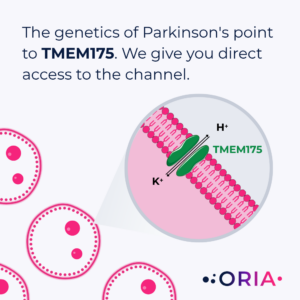



TMEM175: the lysosomal pH channel at the center of Parkinson’s genetics
TMEM175 is a lysosomal K⁺/H⁺ channel with a structurally unique architecture relative to canonical potassium channels. It stabilises luminal pH by balancing V-ATPase proton pumping, a function directly required for GCase activity and, downstream, for the clearance of alpha-synuclein aggregates.
When it fails, the cascade is linear, mechanistically grounded, and genetically supported at a scale few targets in neurodegeneration can match.
𝗧𝗵𝗲 𝗴𝗲𝗻𝗲𝘁𝗶𝗰 𝗰𝗮𝘀𝗲
TMEM175 sits at one of the strongest genetic loci in Parkinson’s disease GWAS. The causal variant, p.M393T, reduces lysosomal K⁺ current by approximately 40% and has been directly linked to earlier disease onset and accelerated progression. This is not a candidate association. It is one of the strongest genetic signals in the entire NDD field.
𝗧𝗵𝗲 𝗳𝗶𝗲𝗹𝗱 𝗶𝘀 𝗺𝗼𝘃𝗶𝗻𝗴
In 2024, the first selective TMEM175 inhibitors were published, with cryo-EM structures revealing their pore-blocking mechanism. The pharmacology is being built, and the race for the right modulators is open. Characterising those modulators demands direct access to the channel in native lysosomal membranes.
This is exactly why we built 𝐋𝐘𝐒𝐎-𝐏𝐫𝐞𝐩™ for at ORIA Bioscience.